What I love about working in this field is not only the variety of people I get to meet and help on a daily basis, but also the challenges of working and organizing in many different spaces. I’ve recently began a project for a friend of mine organizing his condominium storage locker. Two lockers, actually. One was a very small unit, and the other was a much larger unit. For those of you who don’t know, the majority of walls in a storage locker are made of a network of wire grids. In some instances you’ll find these similar to that of a chain link fence, and in other instances, the wire is thick, heavy duty, with no flexibility, similar to that of a dog cage. In this case, it is the latter.
My friend generally uses the smaller storage unit for long-term storage items, such as antique furniture pieces and memorabilia, but other items were thrown into the mix. When sorting through this unit , we found snowboards, old hockey bags, old jackets and a bunch of other “stuff”. When we pulled everything out of the unit were we amazed at how much was actually packed into it. Problem was, you couldn’t see most of it so there were some surprises for my friend. Two of the items in this unit are wood storage trunks. Inside the trunks we found very old record albums in green garbage backs dating back to early 1900’s. Unfortunately, there was an extensive amount of mold damage, much of which was apparently pre-existing before even being placed in the trunk many years ago. Storing these trunks in the underground storage locker may or may not have contributed to the problem. Although the locker did not feel as if moisture existed, it’s generally always an issue because of the concrete floors which tend to pull moisture up from the ground. We ultimately had to dipose of many of the albums but were also able to save several. Once the moldy albums and bags were removed from the trunks, we had some new-found storage space within the trunks themselves which we utilized to the max. Keeping in mind the ultimate purpose for this particular unit, we removed any items for which access would be frequent and designated them to the larger locker. We even freed up space so that infrequently used items currently in the larger unit were assigned to this long term space.
Moving on to the larger storage locker, we sorted all the items into categories, such as sports gear, household items, automotive items, etc., and were then able to see exactly what needed to be contained in the space. Everything was put back in the unit on a temporary basis and in a temporary fashion pending the purchase of the organizing products and accessories needed to properly set up the space. With a fairly low budget I headed out to shop. This was more of a challenge than sorting through the two units combined. The unique challenge in this case was finding the appropriate hooks in the right size to hang sports items up on the grid wall system without alot of trouble. “S” type hooks are the quick fix option but they tend to flip right off the grid wires and get lost. Carabiners can be helpful but only if the opening is large enough to easily hook onto the item that needs to hang. I needed at least a 5″ carabiner to do the job. If my client has to struggle to get a heavy item on or off of a hook or fastener, then that’s not a very good option as it will not only be frustrating but potentially dangerous as well. During my shopping extravaganza I’d be lying if I said I wasn’t getting frustrated at the lack of appropriate fasteners for the job. Perhaps this is a sign that I need to invent something!
Being inventive and creative in this industry is a necessity as we are frequently called upon to “create space” where none appears to exist. One of my colleagues had a great idea for creating storage in a locker such as this. He once used the frame of an old Ikea bookcase (shelves removed), raised it off the concrete floor to protect it from moisture, and inserted hooks on the top and sides of the bookcase framing to hang up items in a storage unit. He then drilled holes through the framing and securely fastened the framing to the wire grid wall with wires. It’s not “pretty” but it’s functional because it made it possible to securely hold fasteners on which sports gear could be hung, which is ultimately what his client wanted.
The idea of using the frame of an old bookcase is a good option for some people, although not one that would work for my friend. So after over 2 hours of scouring the major, and some smaller, hardware and big box stores, I came back to my office with a large assortment of hooks and fasteners, satisfied that I had gathered every possible option. Ultimately I know that I”ll be returning some products, but at least I will be prepared. I go back to perform the final organization and set up of the locker on Saturday so I’ll let you know how it turns out and post some pictures as well. Wish me luck!
 905-642-5669

 ClutterBGone Inc. Featured by BACD — and Varsha Singh Recognized for International Women’s Day!March 24, 2026 - 2:35 pm
 How Clutter Can Affect Your Relationships: A Closer LookAugust 31, 2023 - 2:48 pm
 905-642-5669


Organizing Your Life
in Home OrganizingWe all need to start thinking about subcontracting chores and jobs out for (i) things that we just aren’t good at, (ii) things that are outside our scope of expertise, (iii) things that we hate doing or (iv) that we physically or mentally cannot do. On my recent appearance on Rogers Daytime television, one of the co-hosts, Jeff Moore, said just that. If you really don’t want to tackle something on your own, then why do it?! So often I hear my clients say to me “I really should be able to get this space organized on my own”. Really? Why? Do you really have the time? The skills or the energy? At my own home I find there are a number of “chores” and other things that we need to outsource so that we can spend time on things that are important to us as well as to reduce the physical toll. What would it take to get you to outsource some of the responsibilities that keep your home or office running smoothly? Cut yourself some slack and give yourself permission to hire someone to help reduce your stress, gain control of your life and make room for living? I have, and it’s feels pretty good!
Spring Cleaning – Storage Locker Organization
in Downsizing, Home OrganizingAs you know from my previous post, I was faced with the challenge of organizing two condominium storage lockers for “spring cleaning”. It was quite a challenge as the owner of the lockers, as well as his two sons, are sports enthusiasts and involved in everything from hockey, lacrosse, golf, fishing to mountain biking and more. The main storage locker had to accommodate all the sports gear for easy transitioning from one type of sport to another, as well as store all seasonal items. As you can see from these photos, the locker was an obstacle course and in a state of disorganization making it virtually impossible to maneuver and reach anything without tripping and falling over stuff.
Faced with two concrete walls and two wire grid walls, being creative and having a vision was essential to be successful in this project. Most condominiums have very strict rules regarding storage lockers and what you can and cannot do. Utilizing new storage shelving, re-configuring the space and sectioning off parts of the locker into specific zones for sports and seasonal holiday items was the most efficient and functional way to work through this project without breaking any condominium rules. My client was so excited about this project that within 30 minutes of starting the final organization and set up session, he actually sent his girlfriend down to see what was happening with the space. Then not long after that he came down himself, on 2 or 3 different occasions, to “nonchalantly” check it out and see the transformation take place. He was like a little boy at Christmas, he just couldn’t wait. When I completed the final touches and he came down for the big reveal, he was in fact thrilled with the outcome. Here’s the picture I took after the project was completed.
It was a challenging experience and the outcome was a successful transformation into a fully accessible, safe and functional space. Look! You can even see the floor! What’s your next challenge?
Storage Locker Chaos
in Home Organizing, Move OrganizingWhat I love about working in this field is not only the variety of people I get to meet and help on a daily basis, but also the challenges of working and organizing in many different spaces. I’ve recently began a project for a friend of mine organizing his condominium storage locker. Two lockers, actually. One was a very small unit, and the other was a much larger unit. For those of you who don’t know, the majority of walls in a storage locker are made of a network of wire grids. In some instances you’ll find these similar to that of a chain link fence, and in other instances, the wire is thick, heavy duty, with no flexibility, similar to that of a dog cage. In this case, it is the latter.
My friend generally uses the smaller storage unit for long-term storage items, such as antique furniture pieces and memorabilia, but other items were thrown into the mix. When sorting through this unit , we found snowboards, old hockey bags, old jackets and a bunch of other “stuff”. When we pulled everything out of the unit were we amazed at how much was actually packed into it. Problem was, you couldn’t see most of it so there were some surprises for my friend. Two of the items in this unit are wood storage trunks. Inside the trunks we found very old record albums in green garbage backs dating back to early 1900’s. Unfortunately, there was an extensive amount of mold damage, much of which was apparently pre-existing before even being placed in the trunk many years ago. Storing these trunks in the underground storage locker may or may not have contributed to the problem. Although the locker did not feel as if moisture existed, it’s generally always an issue because of the concrete floors which tend to pull moisture up from the ground. We ultimately had to dipose of many of the albums but were also able to save several. Once the moldy albums and bags were removed from the trunks, we had some new-found storage space within the trunks themselves which we utilized to the max. Keeping in mind the ultimate purpose for this particular unit, we removed any items for which access would be frequent and designated them to the larger locker. We even freed up space so that infrequently used items currently in the larger unit were assigned to this long term space.
Moving on to the larger storage locker, we sorted all the items into categories, such as sports gear, household items, automotive items, etc., and were then able to see exactly what needed to be contained in the space. Everything was put back in the unit on a temporary basis and in a temporary fashion pending the purchase of the organizing products and accessories needed to properly set up the space. With a fairly low budget I headed out to shop. This was more of a challenge than sorting through the two units combined. The unique challenge in this case was finding the appropriate hooks in the right size to hang sports items up on the grid wall system without alot of trouble. “S” type hooks are the quick fix option but they tend to flip right off the grid wires and get lost. Carabiners can be helpful but only if the opening is large enough to easily hook onto the item that needs to hang. I needed at least a 5″ carabiner to do the job. If my client has to struggle to get a heavy item on or off of a hook or fastener, then that’s not a very good option as it will not only be frustrating but potentially dangerous as well. During my shopping extravaganza I’d be lying if I said I wasn’t getting frustrated at the lack of appropriate fasteners for the job. Perhaps this is a sign that I need to invent something!
Being inventive and creative in this industry is a necessity as we are frequently called upon to “create space” where none appears to exist. One of my colleagues had a great idea for creating storage in a locker such as this. He once used the frame of an old Ikea bookcase (shelves removed), raised it off the concrete floor to protect it from moisture, and inserted hooks on the top and sides of the bookcase framing to hang up items in a storage unit. He then drilled holes through the framing and securely fastened the framing to the wire grid wall with wires. It’s not “pretty” but it’s functional because it made it possible to securely hold fasteners on which sports gear could be hung, which is ultimately what his client wanted.
The idea of using the frame of an old bookcase is a good option for some people, although not one that would work for my friend. So after over 2 hours of scouring the major, and some smaller, hardware and big box stores, I came back to my office with a large assortment of hooks and fasteners, satisfied that I had gathered every possible option. Ultimately I know that I”ll be returning some products, but at least I will be prepared. I go back to perform the final organization and set up of the locker on Saturday so I’ll let you know how it turns out and post some pictures as well. Wish me luck!
The Upside To Downsizing
in Downsizing, Moving SeniorsBelieve it or not, there is an upside to downsizing. In addition to the benefits of getting organized in general, such as:
there is also an opportunity for you to start a more secure and socially active way of life with more free time and the ability to do more of the things you enjoy and things that are important to you.
When you downsize you reduce the amount of stuff you own. In doing so, you may also find you have more space. For example, wouldn’t it be great if you could actually store your car in the garage! I can’t tell you how many clients I have that are simply unable to do that because of the all the “stuff” currently situated in that space. Imagine that! Actually putting your car into a garage!
And let’s face it. Many seniors need room to move around in a space. Too much stuff creates barriers to safe living.
If barriers exist due to excess furniture and belongings, you’ll need to downsize your living space to reduce the amount of furniture in your home.
But scaling down from many rooms to just a few is a massive job. What’s really important is the type and amount of furniture that will fit in your new space. There will be instances where some spaces may have to do double duty. For instance, in your new home the living room may also have to serve as your office or your craft room. This means looking for items for your home that are multi-functional, such as a console/sofa table that you can also use as your desk. You’ll need to be creative.
When it comes to downsizing, start with a single step. If you love it, keep it, if you don’t, use the opportunity to let it go.
Ultimately, downsizing is also the process of sorting through all kinds of stuff to determine what is most meaningful and important. By removing the clutter, the treasures that are most meaningful will have more space so they can be treasured EVEN MORE!!!
Downsizing.
Many are doing it for a better quality of life. So can you. Are you up for the challenge?
#1 Way To Pack For Travel – Rise And Hang Luggage
in Home Organizing, Move OrganizingI am so thrilled to have discovered this amazing and very creative luggage system for travel that I must share it with you. In fact I am so jazzed by this new product that I demonstrated it this morning live during my organizing segment on Rogers Daytime TV. It’s the Action Pak Duffel Bag by Rise and Hang, created by a very talented young man here in Ontario, Lee Renshaw. As a frequent traveller he was often frustrated with the packing and unpacking of his suitcase into hotel dresser drawers (as well as the fear of potential bed bugs, mold or dirt) and so he designed this hanging system for luggage which essentially involves never having to unpack your suitcase on a trip. You simply hang up the Rise and Hang bag on your closet rod, pack it up with your clothes, toiletries, etc., and when you arrive at your hotel room, you simply unzip the bag, pull up the interior handles and hang your luggage on the closet rod in your hotel room.
There is no unpacking involved as everything is already neatly sorted, organized and placed on individual shelves within the luggage unit. There’s even a spot for dirty laundry at the bottom interior of the bag. This bag was designed for shorter trips, but if you pack light it can easily store enough clothing for a week. The price point is extremely reasonable at $69.99. Rise and Hang also has other products called Insert Paks that fit inside your existing suitcase. One insert can fit inside a smaller suitcase and two inserts can fit inside a large suitcase giving you two organized spaces for clothing . They are also expanding their line of products and currently working on a design for a gym locker. It’s great to see young, local talent contributing with innovative ideas to help people stay organized while travelling. Gotta love it!
Organizing a Pinball Workshop
in Downsizing, Home OrganizingThis has to be one of my favorite projects to work on. This wonderful gentleman with a great sense of humour called to say he really needed my help with his workshop. As a pinball hobbyist in his spare time he fixes and refurbishes pinball machines back from the time when I was growing up including the newer models of machines. When I visited his basement workshop to assess the project, there were literally hundreds of tools and miscellaneous items strewn throughout the shop, various pinball machines in different stages of repair (or disrepair as the case may be) as well as tons of little parts, glass templates, schematics, and various household workshop items. It was virtually impossible for anyone to work in the space or let alone find anything.
As we began the process of sorting items, we came upon dozens of items for which there were doubles, triplicates and more. All because this gentleman couldn’t see what he owned, so he just kept buying more of what he thought he needed. I’ve never seen so many utility knives and screw drivers in one workshop before! By the end of our project, my client had generously donated literally hundreds of dollars of tools to the Habitat for Humanity ReStore. Of course, part of this process of sorting and categorizing provided me with a pretty good education in pinball machine parts one could only dream of. In fact, I dreamt of pinball flippers, thumper bumper parts, coils, bulbs, fuses, ball bearings, springs and more! Of course, the goal for this project was to have every item sorted, categorized and contained so that my client could see exactly what he had for tools, parts and accessories. This took a lot of planning and a clear vision for the outcome.
The end result was pretty spectacular given that we were working within a budget and making every attempt to use containers that were already available to us in the space. We did need to purchase shelving for the shop as well as a number of specific containers, but overall cost for products was less than $250.00. At the end of the last session when I was completing the final set up, my client asked that he be led into the room with his eyes closed just like on television. Upon entering the room and opening his eyes his reaction could not have been any better. After a couple of “omigods” and “wows” from both him and his wife, they could not seem to believe their eyes.
This was the first time I actually received goosebumps from a client’s reaction. Maybe I should have them all come in with their eyes closed! It was great and they are thrilled. And even better than that? He invited me to play a game of pinball on one of his refurbished machines. I scored over 100,000 points (probably not too exciting for most people) and it brought me back to my teenage days. And today he sent me an email saying he was moving into his workshop he loved it that much! Goosebumps, pinball, happy clients…..what more could I ask for!? When was the last time your clients gave you goosebumps?
Helping Children Let Go
in Organizing with KidsI work with many families with young children which is a very interesting and rewarding experience for me. Interesting because the interaction between a parent and child when reviewing the items that the child owns is actually very revealing. I will pick up an item and ask the child when he/she last played with this or if he or she likes the item, dislikes the item and would like to let it go for donation. If the child tells me that it’s no longer one he/she wishes to keep, there are times when the parent jumps in to say things like “oh, but that was so expensive and you play with that all the time, you want to keep this don’t you? When the child responds to the negative and continues to express a desire to let it go, the parent may still be persistent in wanting to keep the item. As a result, I generally have a chat with the parent before the editing part of the process to request that their child be allowed to make the decision and that that decision be respected rather than questioned. This helps the child to not only learn to express and understand what things are important to him or her and to distinguish treasured items from non treasured items, but also teaches the child responsibility, respect and how to be charitable. I always encourage families to include the child in the actual trip to the donation centre in order to live the full experience of donating to others. Children really do get this and how it will positively impact the life of another child.
The revealing part of the process is the parents reaction to the generousity of the child. Often it is evident that it is the adult that has difficultly letting go of items. This reluctance to let go and often the need for abundance can stem from previous learned behaviors or psychological reasons. which may ultimately be passed along to the child if not careful. dThe client is often surprises by their own reaction to the editing process with children.
Teaching children how much stuff is too much stuff may be a difficult task. However, as I was organizing the bedroom of a young 8 year old boy I was startled to come across a book he had in his room authored by the great Robert Munsch and Michael Martchenko entitled “Too Much Stuff”.
The book is about a young girl named Temina who is going on her first airplane trip and is determined to bring ALL her toys regardless of what her mother says. The ending is wonderful and the book is a great teaching tool for all parents in helping their children to let go of things. I urge you to check out this book and let me know what you think about it. I’d love to hear from you.
Principles of Storage
in Home Organizing, Move OrganizingOften times we end up storing items in the most inefficient and non-functional places. For instance, I have a client who stores her baking items in the pantry on the very top shelf where it is not only difficult for her 5 foot frame to reach, but also problematic as she is elderly and arthritic. Another client cannot bear to get rid of paperwork “just in case”. These two scenarios create obstacles to organized living.
So here’s a few basic principles for storage of a variety of items in your home.
Items that are used most often should be stored within easy reach. Items used infrequently should be stored below the waist. Items seldom used and that are lightweight only, should be stored above the head. Do not store anything heavy above your head as this can lead to serious injury!
For paper, here are a few questions you can ask yourself if you are struggling with whether to keep it or toss it:
For clothing, ask yourself these questions
You can also consider adjusting your buying habits. Before making a purchase, decide what the new item will replace and where it will be stored to avoid duplicating items. Don’t forget the “one in one out” rule. Avoid bulk purchases if you are challenged for space. Mega sized items take up mega space. You may be saving money but you are spending vital space as mega purchases take up prime real estate.
I know I’ve also mentioned this before but it’s worth repeating. Ask for gift receipts to avoid storing gift items that don’t suit or fit you, are not your style or you don’t care for. Most important is to resist storing items for fear of offending the gift giver. Re-gift new items or hold a swap party. It’s fun, a great reason for friends to get together and you may end up with something else you can really use and enjoy.
.
The Process of Organizing – 5 Easy Steps
in Home OrganizingHow do I get organized?. How do I even start to get organized? These two questions are ones that I hear not only from clients but from colleagues, friends and family as well. To answer these questions I’m going to provide you with five basic principles to organize pretty much anything.
And here’s a little added bonus for you on the principles of storage in a closet. Items that are used most often should be stored within easy reach. Items used infrequently should be stored below the waist. Items seldom used and that are lightweight only, should be stored above the head.
These points should give you a good start on your next project in getting organized so you can make room for living! Get your project started and tell me how things are going. I’d love to hear about your successes and your challenges! And if you need some help, let me know.
Clutterbgone Television Debut on Rogers
in Home Organizing, Move Organizing, Organizing with KidsYesterday was an interesting day for me. I appeared on Rogers daytime TV with hosts Elaine Yim-Spencer and Jeff Moore to talk about professional organizing and to demonstrate a few pretty cool products to get your life and home organized. Here’s the video: http://www.rogerstv.com/page.aspx?lid=237&rid=17&gid=89952
Neat Freak was great enough to supply me with components of the Neat Kids Closet Max organizing system.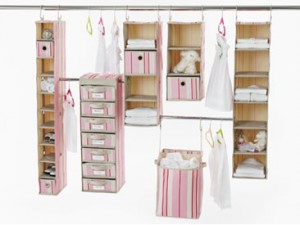
I just love this product for children’s closets because it grows with your child, makes the clothing accessible to them and teaches children the skills of organizing at a young age. The components are made of durable fabric and strong nylon strapping and comes in two patterns: Pop Rock and Candy Stripe. Even better is that no tools are required to assemble the system, it’s quick and easy and uses your existing rod in the closet. It’s specifically designed to hold kid-size clothing and items and you can mix and match the different components to create your own unique and custom closet system. The price point is amazing and you can create a very functional system in a small closet for less than $200.00 easy!
I also demonstrated the Day ja View Recurring Events Calendar which was designed by Sharon Neiss, a professional young mother of three.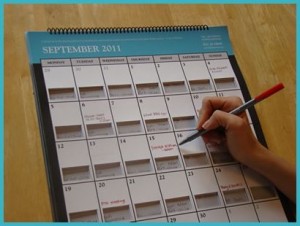 This calendar won the Parent Tested Parent Approved award for 2011 and is currently patent pending. It’s great for families and organizing your events and activities in minutes with its ingenious 3 step design. It’s definitely a winner for families and retails at only $19.99.
Lastly I was able to demonstrate the Grid It! organizer generously provided by Cocoon Innovations.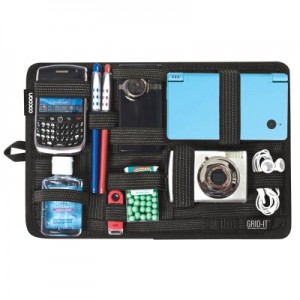 It comes in a bunch of different sizes, and is an extremely versatile and functional solution to organizing your digital devices and personal items. It’s made of rubberized woven elastic that firmly holds your stuff in place and there are endless configurations so you can customize the product to suite your specific needs. It’s a great idea for laptops, Ipads, travel cases, knapsacks and essentially any carrying bag. The price point varies depending on the size, but you can get a very functional one for about $19.00.
All in all a pretty great day. I’ll be back on Rogers Daytime TV in February and will keep you posted.