5 Reasons Cluttered Homes Don’t Sell

De-cluttered home that sellsThis article was originally published on the Comfree Blog, where I am a frequent contributor. You can view the original article here.

You’ve got several people in line to take a look at your house that you’ve just put up for sale. The lawn is immaculate, the driveway is as smooth as glass, and there isn’t a single wrinkle in your clothes. However, behind closed doors lies a completely different story.

“I know where to find everything in my own house!” you might argue. That might very well be true for you, but what about the couple looking at your home for the first time? Are they convinced?

It turns out that it does matter to other people whether your home is presented as spic and span or as the remnants of a hurricane. The “hygiene” of your house can potentially be the difference between a brief, disinterested house tour and an enthusiastic down payment.

Here are five reasons cluttered houses don’t sell and why you should clear the clutter before putting it on the market.

1. First impressions are critical

From the moment a potential buyer sets foot in the house their opinion on how suitable it is as a home depends greatly on first impressions. It makes sense. Why buy something that doesn’t deliver your specific needs?

It’s critical to ensure that every room conveys its purpose. There shouldn’t be plates in the living room nor should there be newspapers scattered in the kitchen. Only when everything is in its rightful place can a potential buyer assume that the house offers living space appropriate to his or her needs.

2. Potential buyers need to be able to visualize themselves in the home

Not that you need to encourage anyone to make themselves feel at home but if you’re hoping to make a sale you want potential buyers to relate to you as a homeowner. The couple taking a look around your living room should be able to picture themselves sitting on the couch with their feet on the coffee table after a long day.

If your couch is covered in dog fur and your coffee table is littered with old mail, chances are they’re not picturing anything of the sort.

3. Buyers want a home with lots of space to live in

Ultimately, you want to present your house as a place that is suitable for comfortable living. Spaciousness is crucial in illuminating the potential of the house in that regard.

With the right furniture arrangement you can make that effort to appease potential buyers and demonstrate that they too can enjoy living in this very house with as much or as little space as they desire. But of course show them more space as opposed to less and let them see what they’re working with.

4. Your closet says a lot about you

Someone taking a look in your bedroom might like to see how much closet space your room has. Probably so they can know how much junk they can store inside without rhyme or reason.

You should not, however, use your closet that way, at least not during a tour of the closet. Everything inside should be neat and orderly. If you have clothes or other items spilling out, a potential buyer might believe that their own mess won’t fit inside. The trick is to avoid presenting them with a mess in order to show off how much space there actually is.

5. Messy home = messy owners

You know that saying “never judge a book by its cover”? Forget that. Consider yourself judged. How you physically present yourself doesn’t matter nearly as much as how you physically present the house, seeing as it’s the house people are interested in buying.

A messy, cluttered house tells potential buyers that the owners have messy, cluttered minds. If you don’t even have time to wash that tower of plates on the kitchen counter, how is anyone supposed to believe that you have time to clean and maintain facilities within the rest of the house?

Downsize And Simplify Your Life

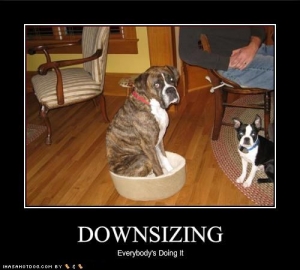
downsizing

Downsizing is creating in a smaller space and can often be a daunting process.  For seniors it can be even more overwhelming, especially when you have lived in a home for several decades collecting numerous possessions along the way.

Every year, thousands of older adults and seniors leave their larger homes for smaller, more manageable spaces.

Several reasons exist for seniors who want or need to downsize.

According to some of my clients it’s because they no longer want the burden of home ownership.  For others the kitchen is too difficult in which to manoeuvre and retrieve items, or the home is too far from grocery stores and banks. Often times the hallways in older homes are too narrow and there are too many stairs. Housekeeping is difficult to keep up with and for many physical and health issues make caring for a home too difficult.

If you are considering taking the plunge to a more simplified way of life there are a few things you can do to get started before you move.

First, look at the top shelves in your home.  The ones you can’t reach.  If you have items on any tops shelves in your current home it’s because you either don’t need them or can’t reach them.  Whichever the case, it’s likely a safe bet that you can let those items go.

Secondly, don’t hold yourself hostage to being a keeper of all the heirlooms from your family. I’ve heard from many clients that this is their primary reason for not letting go of items they no longer have room for. Take a photo of the item and then send it to other family members to see if anyone would be interested in taking the item.  If not, you know that it is safe to donate to charity or send it along to a consignment store without causing family despair.

Thirdly, remember you can still keep the memories without keeping every possession that goes with that memory.  Consider taking swatches of cloth from special, treasured items and a few tokens of memorabilia and creating a memory box rather than keeping every single item.

Consider how much you can gain from downsizing to a smaller home. Think of it as an opportunity to start a more secure and socially active way life so you can do more, have more free space and room to move around without barriers to safety.

Lastly remember that you are still you without all your stuff.  We are only a caretaker of our stuff.  When we pass on, someone else becomes that caretaker. It’s better to downsize now when you are physically able and can still make the decisions on what to keep and what to let go of than have to do it when the choice is taken away from you. Ultimately, downsizing is the process of sorting through all kinds of stuff to determine what is most meaningful and important.

To downsize is to simplify, lighten up and get organized. Remember, the important things in life are not things. It’s the people who are important.  Just keep the memories, not the stuff.

The Upside To Downsizing

Believe it or not, there is an upside to downsizing.  In addition to the benefits of getting organized in general, such as:

  • Reduced stress and frustration
  • Improved quality of life
  • Increased energy & productivity
  • Paying your bills on time

there is also an opportunity for you to start a more secure and socially active way of life with more free time and the ability to do more of the things you enjoy and things that are important to you.

When you downsize you reduce the amount of stuff you own.  In doing so, you may also find you have more space.  For example,  wouldn’t it be great if you could actually store your car in the garage! I can’t tell you how many clients I have that are simply unable to do that because of the all the “stuff” currently situated in that space.  Imagine that! Actually putting your car into a garage!

And let’s face it.  Many seniors need room to move around in a space.  Too much stuff creates barriers to safe living.

If barriers exist due to excess furniture and belongings, you’ll need to downsize your living space to reduce the amount of furniture in your home.

But scaling down from many rooms to just a few is a massive job.  What’s really important is the type and amount of furniture that will fit in your new space. There will be instances where some spaces may have to do double duty.  For instance, in your new home the living room may also have  to serve as your office or your craft room. This means looking for items for your home that are multi-functional, such as a console/sofa table that you can also use as your desk. You’ll need to be creative.

When it comes to downsizing, start with a single step.  If you love it, keep it, if you don’t, use the opportunity to let it go.

 Ultimately, downsizing is also the process of sorting through all kinds of stuff to determine what is most meaningful and important. By removing the clutter, the treasures that are most meaningful will have more space so they can be treasured EVEN MORE!!!

Downsizing.

downsizing

Many are doing it for a better quality of life.  So can you.  Are you up for the challenge?

Downsizing for Seniors

Downsizing is a tough process in and of itself. For seniors, taking the plunge is even harder. One thing to make it easier it to remove the guilt factor. Although you may feel you’re the one who has to be the keeper of all heirlooms in the family, there are other options. Perhaps there are other family members who would like some of the heirlooms you are closeting in your home, especially if you are in fact storing them as opposed to using them. In sharing with other family members you can feel secure in knowing that they really want them and will be the one to inherit them. I recently did this myself with some items that my father had given to me before he moved back to Amsterdam. I no longer had a physical place to store them, and knowing that they always have a place in my heart made it easier for me to share the items with others in the family who would be in a position to enjoy them more. And remember, the item is not the memory. The memory lives within you, not in the item itself.